
Weeping willow trees, which are native to northern China, are beautiful and fascinating trees whose lush, curved form is instantly recognizable. Found throughout North America, Europe, and Asia, these trees have unique physical characteristics and practical applications as well as a well-established place in culture, literature, and spirituality throughout the world.
Willow Tree Nomenclature
The scientific name for the tree, Salix babylonica, is something of a misnomer. Salix means "willow," but babylonica came about as the result of a mistake. Carl Linnaeus, who designed the naming system for living things, believed weeping willows were the same willows found by the rivers of Babylon in the Bible. The trees mentioned in the Psalm, though, were probably poplars. Weeping willow trees get their common name from the way that rain looks like tears when it's dripping off the curved branches.
Physical Characteristics
Weeping willows have a distinctive appearance with their rounded, drooping branches and elongated leaves. Though you would likely recognize one of these trees, you might not know about the tremendous variety among different types of willow species.
- Species - There are more than 400 species of willow trees, with most of these found in the Northern Hemisphere. Willows cross with one another so easily that new varieties constantly spring up, both in nature and in deliberate cultivation.
- Varieties - Willows can be either trees or shrubs, depending upon the plant. In arctic and alpine areas, willows grow so low to the ground they are called creeping shrubs, but most weeping willow trees grow to be 45 feet to 70 feet tall. Their width can equal their height, so they can wind up as very large trees.
- Foliage - Most willows have pretty, green foliage and long, thin leaves. They are among the first trees to grow leaves in the spring and among the last to lose their leaves in the fall. In fall, the color of the leaves ranges from a golden shade to greenish-yellow hue, depending on the type.
- Catkins - In the spring, usually April or May, weeping willows produce silver-tinged green catkins that contain flowers. The flowers are either male or female and appear on a tree that is respectively male or female.
- Shade trees - Because of their size, the shape of their branches, and the lushness of their foliage, weeping willows create an oasis of summertime shade as long as you have sufficient space to grow these gentle giants. The shade provided by a willow tree consoled Napoleon Bonaparte when he was exiled to St. Helena. After he died, he was buried under his beloved tree.
- Climbing trees - The configuration of their branches makes weeping willows easy to climb, so children love them and find in them a magical, enclosed refuge off the ground.
Growth and Cultivation
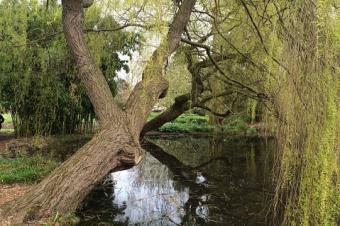
Like any tree species, weeping willows have their own particular needs when it comes to growth and development. With the proper cultivation, they can grow into strong, hardy, beautiful trees. If you're a landscaper or homeowner, you also need to be aware of unique considerations that come with planting these trees on a given piece of property.
- Speed of growth - Willows are fast-growing trees. It takes about three years for a youthful tree to become well-situated, after which it can easily grow eight feet per year. With their size and distinctive shape, these trees tend to dominate a landscape.
- Water - Willows like standing water and will clear up troublesome spots in a landscape prone to pools, puddles, and floods. They also like to grow near ponds, streams, and lakes.
- Soil type - These trees aren't fussy about their soil type, and they're very adaptive. While they prefer moist, cool conditions, they can tolerate some drought.
- Roots - The root systems of willow trees are large, strong, and aggressive. They radiate far afield from the trees themselves. Don't plant a willow any closer than 50 feet away from underground lines such water, sewage, electricity, or gas. Remember not to plant willows too close to your neighbors' yards, or the roots could interfere with your neighbors' underground lines.
- Diseases - Willow trees are susceptible to a variety of diseases including cytospora canker, powdery mildew, bacterial blight, and tarspot fungus. Canker, blight, and fungal infections can be mitigated by pruning and spraying with fungicide.
- Insects - A number of insects are drawn to weeping willows. Troublesome insects include gypsy moths and aphids that feed on leaves and sap and carpenter worms that bore through trunks. Willows do, though, host lovely insect species like viceroy and red-spotted purple butterflies.
- Deer - Willow bark produces a substance similar to aspirin. Deer often rub new antlers against the bark of willow trees to relieve the itch, and this behavior can damage a youthful tree.
- Longevity - Willows aren't the longest-lived of trees. They typically live twenty to thirty years. If a tree is well cared for and has access to plenty of water, it might live for fifty years.
Products Made From Willow Wood
Not only are willow trees beautiful, but they can also be used to make various products. People around the world have utilized the bark, branches, and wood to create items that range from furniture to musical instruments to survival tools. Wood from willow trees comes in different types, depending on the kind of tree.
- White willow wood is used in the manufacture of cricket bats, furniture, and crates.
- Black willow wood is used for baskets and utility wood.
- In Norway and Northern Europe, willow bark is used to make flutes and whistles.
- Willow staves and bark are also used by people who live off the land to make fish traps.
- People can also extract dye from willows that can be used to tan leather.
- Branches from willow trees were used by Native Americans to make paintbrushes, arrow shafts, dolls, and dream-catchers.
- Native Americans made sweat lodges and wigwams from willow saplings.
Medicine From Willow Trees
Within the bark and the milky sap of willows is a substance called salicylic acid. People from various times and cultures have discovered and harnessed the efficacious properties of the substance to treat headaches and fever.
- Fever and pain reduction - Hippocrates, a physician who lived in ancient Greece in the fifth century B.C., discovered that willow bark, when chewed, could lower fever and reduce pain.
- Toothache relief - Native Americans discovered the healing properties of willow bark and used it to treat fever, arthritis, headaches, and toothaches. In some tribes, the willow was known as the "toothache tree."
- Inspired synthetic aspirin - Edward Stone, a British minister, did experiments in 1763 on willow bark and leaves and identified and isolated salicylic acid. The acid caused too much stomach upset to be widely used until 1897 when a chemist named Felix Hoffman created a synthetic version which was gentle on the stomach. Hoffman called his invention "aspirin" and produced it for his company, Bayer.
Willows in Cultural Contexts
You'll find willow trees in a variety of cultural expressions, whether in the arts or in spirituality. Willow trees often appear as symbols of death and loss, but they bring magic and mystery to people's minds, as well.
Literature

Willows appear as potent symbols in modern and classic literature. Traditional interpretations associate the willow with grief, but modern interpretations sometimes chart new territory for the tree's significance.
- Othello - The most famous literary reference to the willow is probably William Shakespeare's Willow Song in Othello. Desdemona, the heroine of the play, sings the song in her despair. You can hear an example and see the musical score and words on Digital Tradition. Many composers have set this song to music, but the version on Digital Tradition is one of the oldest. The earliest written record of The Willow Song is from 1583 and was written for the lute, a stringed instrument like a guitar but with a softer sound.
- Hamlet - Shakespeare uses the mournful symbolism of the willow in Hamlet. Doomed Ophelia falls into the river when the willow branch on which she is sitting breaks. She floats for a while, buoyed by her clothing, but she eventually sinks and drowns.
- Twelfth Night - Willows are also mentioned in Twelfth Night, where they symbolize unrequited love. Viola is dwelling on her love for Orsino when she, dressed as Caesario, replies to Countess Olivia's question about falling in love by saying "make me a willow cabin at your gate, and call upon my soul within the house."
- The Lord of the Rings - In J. R. R. Tolkien's beloved fantasy series The Lord of the Rings, Old Man Willow is an ancient tree with an evil heart. The tree actually harbors a thirsty, imprisoned spirit. Old Man Willow sees men as usurpers because they take wood from the forest, and he tries to capture, then kill the hobbits Merry, Pippin, and Frodo. In another scene, Treebeard, who befriends the hobbits and is the oldest tree in the forest, sings a song about "the willow-meads of Tasarinan."
- Harry Potter Series - If you're a J. K. Rowling fan, you'll remember that the willow is an important character in the Harry Potter book series. The Whomping Willow is a tree with attitude that lives on the Hogwarts grounds and guards the entrance to a tunnel that leads to the Shrieking Shack where Professor Lupin goes when he turns into a werewolf.
Religion, Spirituality, and Mythology
The weeping willow tree is prominently featured in spiritualities and mythologies throughout the world, both ancient and modern. The beauty, dignity, and grace of the tree evokes feelings, emotions, and associations that run the gamut from melancholy to magic to empowerment.
- Judaism and Christianity - In the Bible, Psalm 137 refers to the willows on which the Jews who were held captive in Babylon hung their harps while mourning for Israel, their home. It is thought, however, that these trees might actually have been poplars. Willows also are seen in the Bible as harbingers of stability and permanence when a prophet in the Book of Ezekiel plants a seed "like a willow."
- Ancient Greece - In Greek mythology, the willow goes hand-in-hand with magic, sorcery, and creativity. Hecate, one of the most powerful figures in the underworld, taught witchcraft, and she was the goddess of both the willow and the moon. Poets were inspired by Heliconian, the willow-muse, and the poet Orpheus traveled to the underworld carrying branches from a willow tree.
- Ancient China - Not only do willows grow up to eight feet a year, but they also grow with great ease when you put a branch in the ground, and trees readily spring back even when they endure severe cutting. The ancient Chinese took note of these qualities and saw the willow as a symbol of immortality and renewal.
- Native American spirituality - Willow trees symbolized various things to Native American tribes. To the Arapaho, willow trees represented longevity because of their capacity for growth and regrowth. To other Native Americans, willows signified protection. The Karuks fixed willow sprigs to their boats to protect them from storms. Several tribes in Northern California carried the sprigs to protect them spiritually.
- Celtic mythology - Willows were considered sacred by the Druids, and for the Irish, they are one of seven sacred trees. In Celtic mythology, willows are associated with love, fertility, and young women's rights of passage.
Visual Art
Willows are literally used for art. Sketching charcoal is often made from processed willow bark and trees. Since willows have branches that curve down to the ground and seem to weep, they are often seen as symbolic of death. If you look carefully at paintings and jewelry from the Victorian era, you can sometimes spot a funeral artwork commemorating the death of someone by the illustration of a weeping willow.
Both Practical and Magical
Weeping willow trees are a great gift to humanity because of their delightful combination of practicality and mystery. Their large size and plenteous foliage make them wonderful sheltering trees that are always ready to provide refuge, comfort, and shade. With their beauty and grace, they delight the senses, evoke a sense of wonder, and inspire the heart and spirit.


